

Every child develops at their own pace.
Some children take their first steps early, while others need a little more time. Some children are naturally very chatty, while others take longer to find their words. One child may love climbing, running, and exploring, while another may be more cautious with movement.
These differences are often completely normal.
Children do not all reach developmental milestones at exactly the same time, and comparing your child with another child of the same age can sometimes create unnecessary worry.
So, no, every developmental difference does not mean something is wrong.
However, there is a difference between a child simply developing at their own pace and a child showing a consistent pattern of difficulty in an important area of development.
Sometimes, the most helpful thing a parent can do is pause and ask:
“Could my child need a little extra support?”
Early observation does not mean putting a label on a child. It simply means paying attention, asking questions, and getting professional guidance when something doesn’t seem quite right.
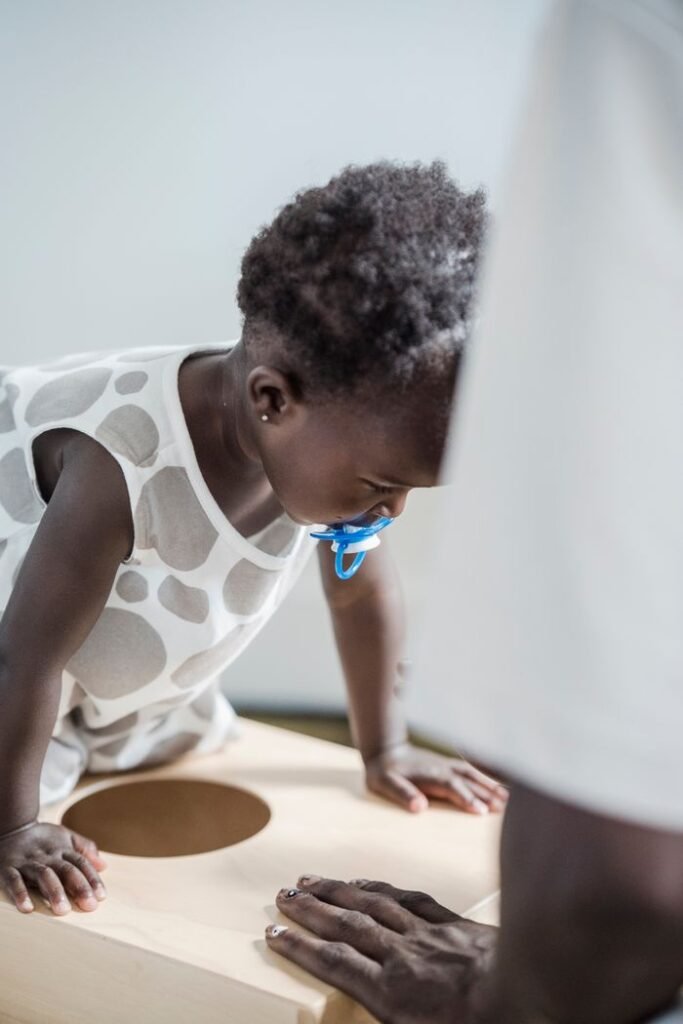
Here are 5 developmental signs worth paying attention to:
1. Your child isn’t walking yet
Walking is an important gross motor milestone because it involves much more than simply putting one foot in front of the other.
A child needs adequate muscle strength, balance, coordination, postural control, and confidence to move independently.
By around 18 months, most children can walk independently. If your child is not yet walking by this age, it is worth discussing their development with a healthcare professional.
You may also want to pay attention if your child is walking but you notice ongoing difficulties with:
- Balance
- Coordination
- Getting up from the floor
- Moving from one position to another
- Climbing or navigating simple obstacles
- Using both sides of the body together
- Frequent falls that seem unusual for their age
One delayed milestone does not automatically mean there is a serious problem.
However, persistent difficulty with movement can sometimes indicate that a child would benefit from an assessment to better understand their motor development.
And remember:
Don’t compare children. Pay attention to patterns.
Your friend’s child may have started walking at 10 months, while yours started at 15 months. That difference alone does not tell you that something is wrong.
What matters is understanding your child’s individual developmental journey.
2. Head control still seems difficult
Head control is one of the early foundations of a baby’s physical development.
During the first few months of life, babies gradually develop stronger neck and upper-body muscles. They begin to hold their heads more steadily when being held and, during tummy time, gradually become better able to lift and control their heads.
If your baby continues to struggle to hold their head steady, particularly beyond the period when you would expect head control to be developing, it is worth speaking with a healthcare professional.
You may also notice other things that make you wonder about your baby’s physical development, such as your baby appearing unusually floppy or stiff, having difficulty maintaining positions, or struggling with movements that seem appropriate for their age.
These observations do not provide a diagnosis on their own.
There can be many reasons why a child may develop certain motor skills more slowly, and a professional assessment can help determine what is happening.
Sometimes, early observation simply helps us understand that a child needs additional support with strength, positioning, movement, or other developmental skills.
The important thing is not to panic.
Notice the pattern. Ask questions. Get guidance when needed.
3. Your child doesn’t respond to their name
You call their name…
Nothing.
You call again…
Still nothing.
It can be concerning when your child frequently seems not to hear you or does not respond when you call their name.
But context matters.
Occasionally not responding to their name is completely understandable. Your child may be deeply focused on a favourite toy, watching something exciting, exploring their environment, or simply not paying attention in that moment.
The concern comes when limited response happens consistently.
For example, you may notice that your child frequently:
- Does not turn when their name is called
- Seems unaware when someone enters the room
- Rarely responds to people speaking to them
- Does not consistently respond to sounds
- Appears to hear some sounds but not others
- Requires repeated prompts to get their attention
There are several things that can influence how a child responds.
Hearing, attention, sensory processing, communication, and social engagement can all play a role.
That is why it is important not to immediately jump to conclusions based on one behaviour.
Instead, look at the whole picture.
How does your child communicate?
How do they interact with people?
Do they respond to sounds?
Do they follow simple instructions?
Do they use gestures?
Do they seek interaction?
If you are noticing a consistent pattern, speaking with the appropriate professional can help you understand what may be contributing to it.


4. Communication isn’t developing as expected
Communication is so much more than saying words.
When parents think about communication, they often focus on how many words their child can say.
But communication begins long before a child starts talking.
A child may communicate by looking at you, reaching for something, pointing, using gestures, making sounds, bringing an object to you, or showing you what they want.
So instead of asking only:
“How many words does my child say?”
Also ask:
- Does my child use gestures?
- Do they point to communicate?
- Do they make sounds or attempt to vocalise?
- Do they use words?
- Do they understand simple language?
- Do they respond to simple instructions?
- Do they show me what they want?
- Do they attempt to get my attention?
- Do they imitate sounds, actions, or words?
- Do they communicate in some way even when they cannot use words?
A child may not be speaking much yet and still have meaningful ways of communicating.
At the same time, if communication seems significantly behind what you would expect for your child’s age, it is worth paying attention.
Parents are sometimes told:
“Just wait. They will talk when they are ready.”
And sometimes children do catch up.
But if you are consistently concerned about your child’s communication, you don’t have to wait indefinitely before seeking professional guidance.
An assessment can help you understand what your child can already do, where the difficulties are, and what kind of support may be helpful.
Early support is not about rushing a child.
It is about giving them the right opportunities to develop.
5. Your child frequently walks on their toes
Toe walking can happen naturally when children are learning to walk.
Some toddlers occasionally walk on their toes, especially when they are excited, playing, or experimenting with movement.
So occasional toe walking does not automatically mean there is a problem.
However, persistent toe walking, particularly beyond age 2, is something worth discussing with a healthcare professional.
It is important to look at the child’s overall movement rather than focusing only on the way they walk.
For example, you may also notice:
- Difficulty keeping their heels down
- Tightness in the calf muscles
- Difficulty with balance
- Frequent tripping
- Difficulty running or jumping
- Differences in coordination
- Difficulty with other gross motor activities
- Sensory-seeking or sensory-avoidant behaviours
Persistent toe walking can sometimes be associated with differences in motor control, muscle tightness, balance, or sensory processing.
There can also be other explanations, which is why an assessment is important.
The goal is not to immediately assume why a child is toe walking.
The goal is to understand why it is happening and whether the child needs support.
NOTICE. ASSESS. SUPPORT. 💙
This is perhaps the most important message for every parent.
This post is not about putting labels on children.
It is not about comparing your child with the child next door, a sibling, a cousin, or another child in their class.
And it is certainly not about panicking every time your child does something differently.
It is about becoming more aware of your child’s development.
When you know what to look out for, you are better able to recognise when something may need closer attention.
And when support is needed, early support can make a meaningful difference.
If you have noticed one or more of these signs, don’t panic.
Instead:
Notice the pattern.
Ask questions.
Seek the right professional guidance.
Understand your child.
Support their development.
Concerned About Your Child’s Development?
Early support can make a life-changing difference.
At Sensorycare, we help children with autism, ADHD, speech delays, sensory challenges, and developmental difficulties build the skills they need to thrive.
Book a consultation today and let’s discuss how we can support your child.
